An independent guide, checked against the official site10 min readCourse as mapped on OpenStreetMap
The 2026 Boston Marathon, the 130th, officially the Boston Marathon presented by Bank of America, ran on Monday 20 April, Patriots' Day, from Hopkinton to Boylston Street in Boston. 32,294 runners were entered, and the organisers expected 30,000 to run.
John Korir won in 2:01:52, a course record by 70 seconds, on what the organisers called almost-ideal conditions. Sharon Lokedi won the women's race in 2:18:51, for her second win in a row.
2026 results: how it went
Men
2:01:52
John Korir, a course record
Women
2:18:51
Sharon Lokedi, back to back
Wheelchair
1:16:06
Marcel Hug, his ninth Boston win
Conditions
7°C
45°F at the start, with a slight tailwind
Korir broke Geoffrey Mutai's course record of 2:03:02, set in 2011, and the next two home, Alphonce Felix Simbu (2:02:47) and Benson Kipruto (2:02:50), finished inside it too. Lokedi's time is the second-fastest winning time in the race's history, after her own 2:17:22 of 2025; Loice Chemnung (2:19:35) and Mary Ngugi-Cooper (2:20:07) followed her. Zouhair Talbi (2:03:45) and Jessica McClain (2:20:49), both fifth, ran the fastest times by Americans on the course. Eden Rainbow-Cooper won the women's wheelchair race in 1:30:51.
It drops from Hopkinton for the first miles and climbs late, through the Newton hills. Run it well and it's quick: John Korir won the 2026 race in 2:01:52, the course record.
Difficulty
3/5 · Rolling
Downhill early, hills late
The organisers call miles 17.5 to 21 the Newton hills. The last of them is Heartbreak Hill, which crests at mile 20.8, and it's mostly downhill from there to Boylston Street.
Best moment
Right on Hereford, left on Boylston
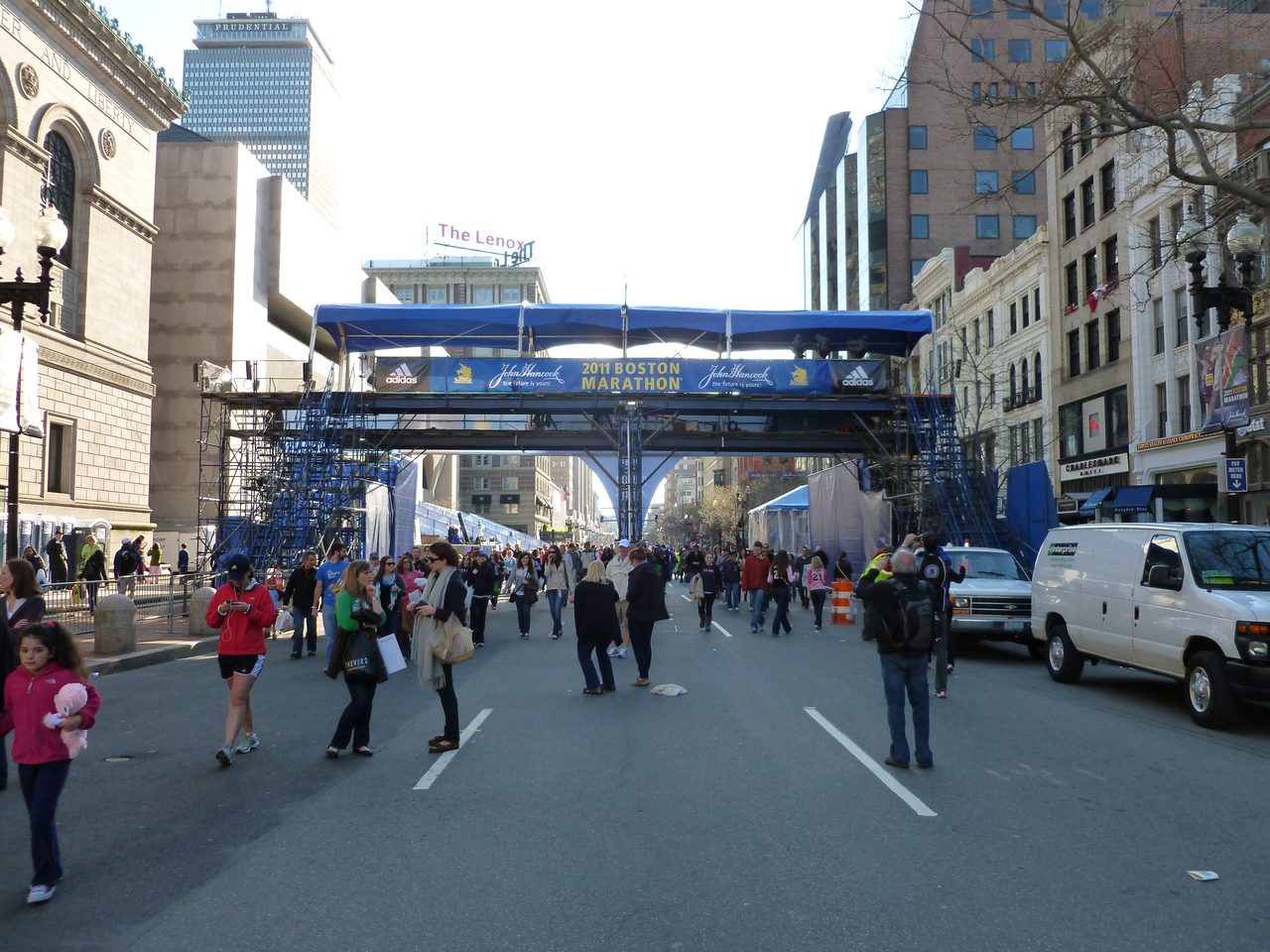
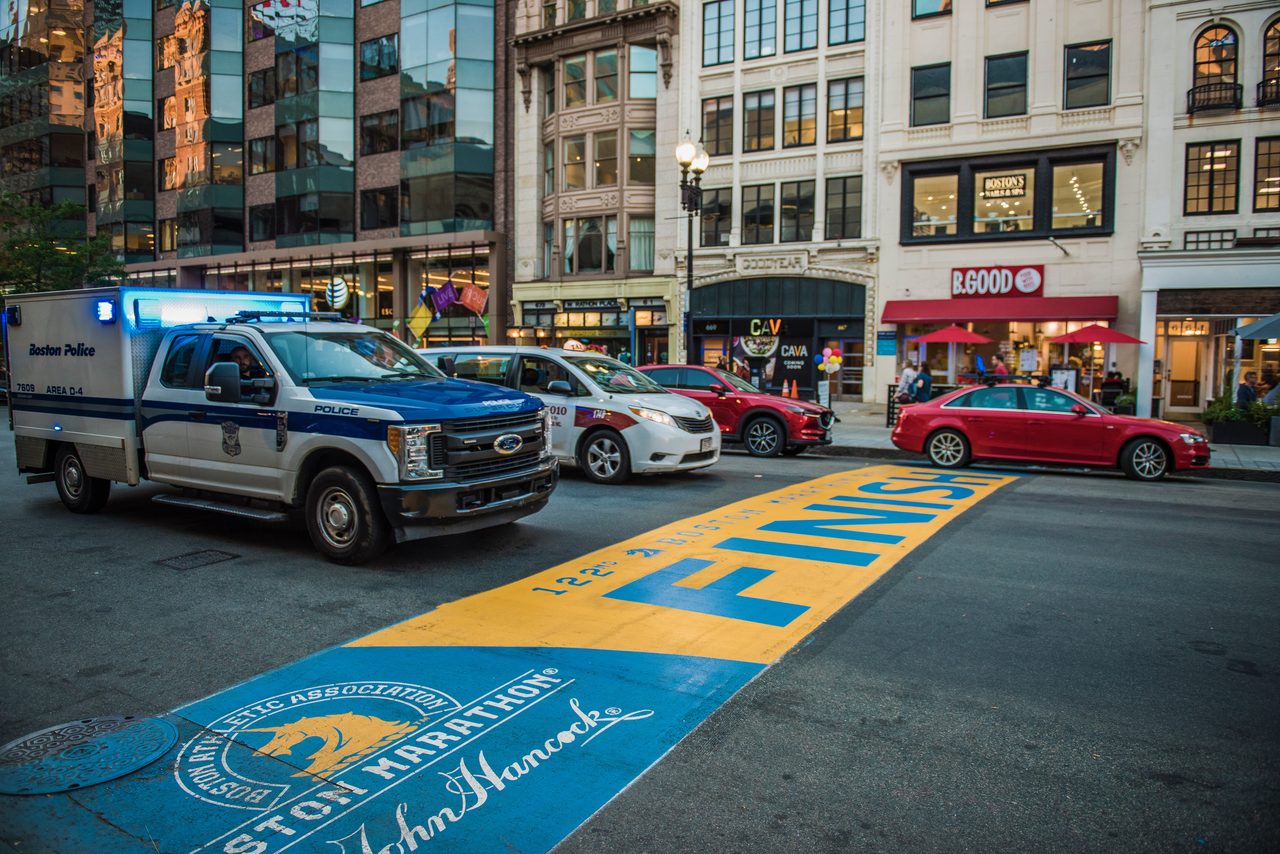
The last two turns of the course, and then the finish straight on Boylston Street, through the crowds to the line by the Boston Public Library.
Runners with a qualifying time, or running for a charity
Anyone who wants the world's oldest annual marathon
Runners who train for the late hills: miles 17.5 to 21
02
Where to take the best photos at the Boston Marathon
The course gives you a painted start line, the Newton hills, the Citgo sign and Boylston Street. Our picks, for supporters with a camera and for runners who carry a phone: step to the side before you stop. The organisers' photographer, MarathonFoto, is out on the course too, and the organisers discourage action cameras and don't allow selfie sticks while you run.
The finish straight, after the turn from Hereford Street, ends at the line by the Boston Public Library. Look up as you cross it: it's the photo you'll frame.
26 miles 385 yards (42.195 km), point to point through eight cities and towns: from Main Street in Hopkinton along Route 135 through Ashland, Framingham, Natick and Wellesley, then Route 16 through Newton Lower Falls, right at the fire station onto Commonwealth Avenue and over the Newton hills, onto Chestnut Hill Avenue to Cleveland Circle, left onto Beacon Street through Brookline to Kenmore Square, under Massachusetts Avenue, right onto Hereford Street and left onto Boylston Street, to finish near the Boston Public Library in Copley Square.
Pick a stretch, or click the course on the map, to see it close up.
0 km51015202530354042.2
km 0–3.1
Hopkinton
The start is on Main Street in Hopkinton, home of the start line since 1924. The road falls away from the line, past the Stylianos Kyriakides 'Spirit of the Marathon' statue at mile 1, to the Ashland town line at mile 1.9.
Start, Main StreetDownhill from the line
Everyone says it and it's true: hold back on the early downhill.
km 3.1–8
Ashland
Route 135 runs on through Ashland, still losing height, from mile 1.9 to the Framingham line at mile 4.95. The first water stations are from mile 2.
Water from mile 2
km 8–12.1
Framingham
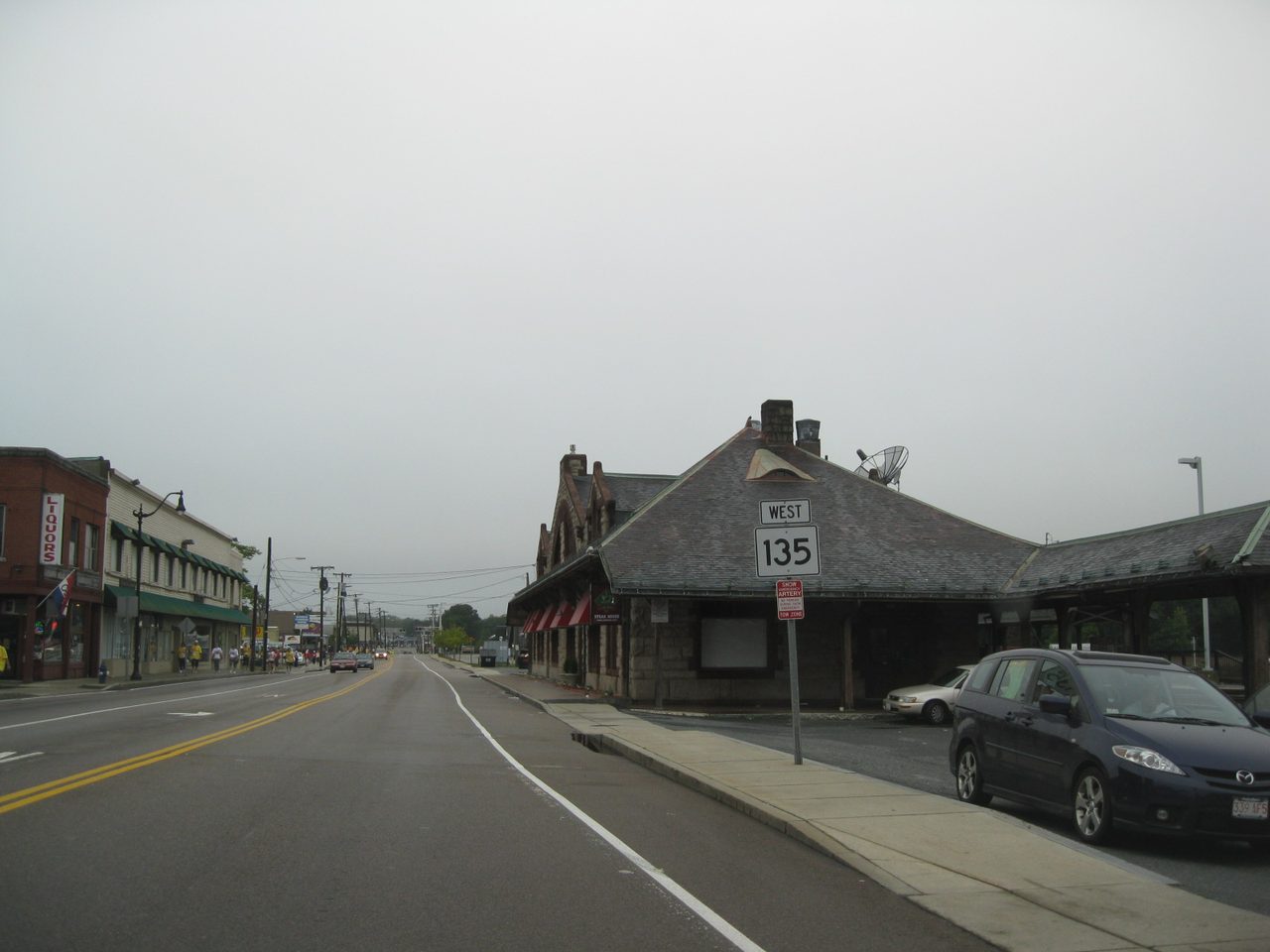
Through Framingham from mile 4.95 to 7.52, past the historic Framingham train depot, beside the road at mile 6.5.
Framingham depot, mile 6.510 km
km 12.1–18.9
Natick
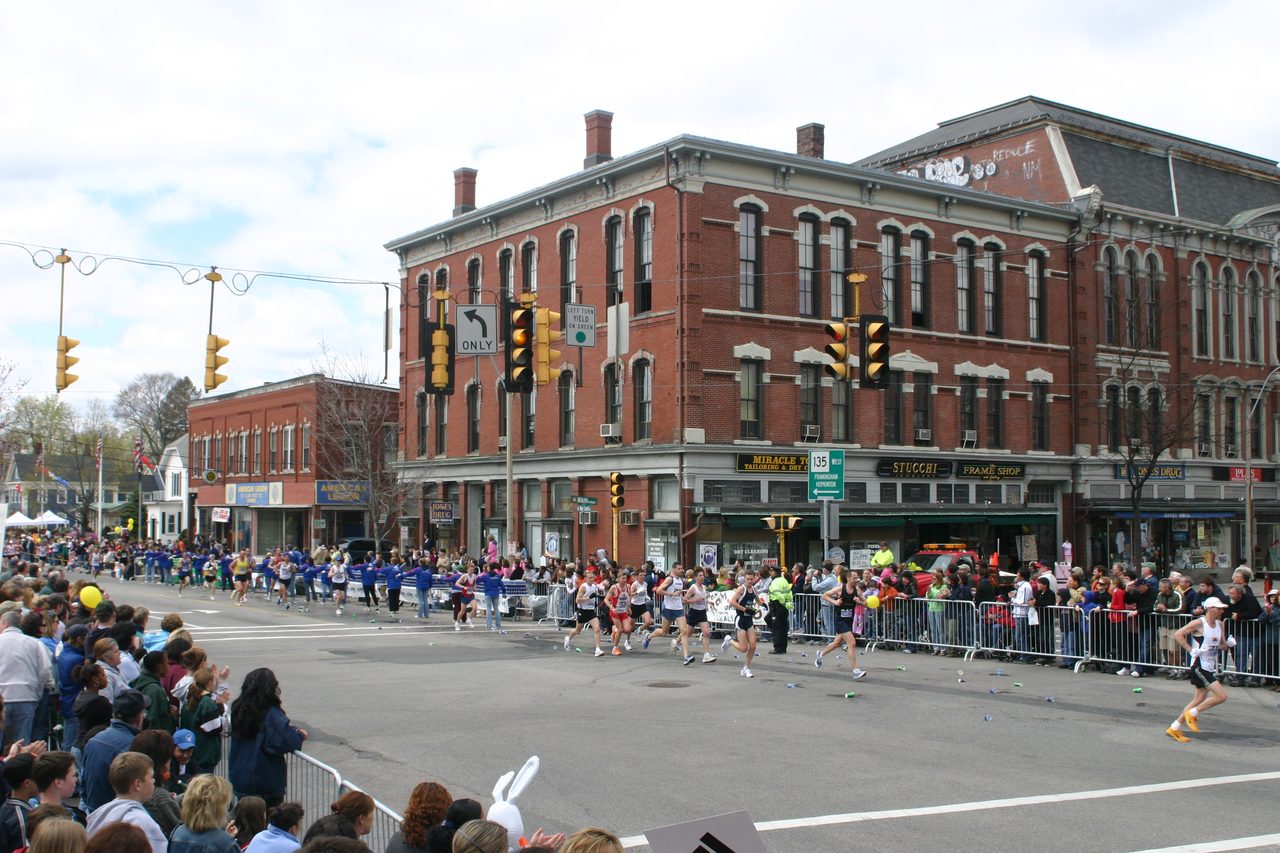
Route 135 runs through Natick from mile 7.52 to 11.72, as West Central and East Central Streets, up to Natick Common, where spectators pack both sides of the road.
Natick Common
km 18.9–25.6
Wellesley and halfway
From the Wellesley town line at mile 11.72, with the first gels at mile 11.8, past Wellesley College and its Scream Tunnel just before halfway, through Wellesley Square and on along Route 16 (Washington Street) to the Newton line at mile 15.93.
Gels, mile 11.8The Scream TunnelHalfway, 21.1 km
The Scream Tunnel is loud and it's tempting to speed up. Save it.
km 25.6–34.4
Newton and its hills
Hardest
Down to the river at Newton Lower Falls, up Washington Street, then right at the fire station onto Commonwealth Avenue, where the organisers' landmark for the start of the Newton hills is Ladder 2, at mile 17.1. The hills run from mile 17.5 to 21: past the Johnny Kelley 'Young at Heart' statue at mile 19.2, to the crest of Heartbreak Hill at mile 20.8.
Gels, mile 17Kelley statue, mile 19.2Heartbreak Hill, crest at mile 20.8
Run the hills by effort, not pace: the time comes back on the way down.
km 34.4–39.8
Boston College and Brookline
Past Boston College, with the last gels at mile 21.5, onto Chestnut Hill Avenue to Cleveland Circle, then left onto Beacon Street, nearly three miles of it, through Brookline from mile 22.45 to 24.7.
Gels, mile 21.5Beacon Street, Brookline
km 39.8–42.2
Kenmore Square to Boylston Street
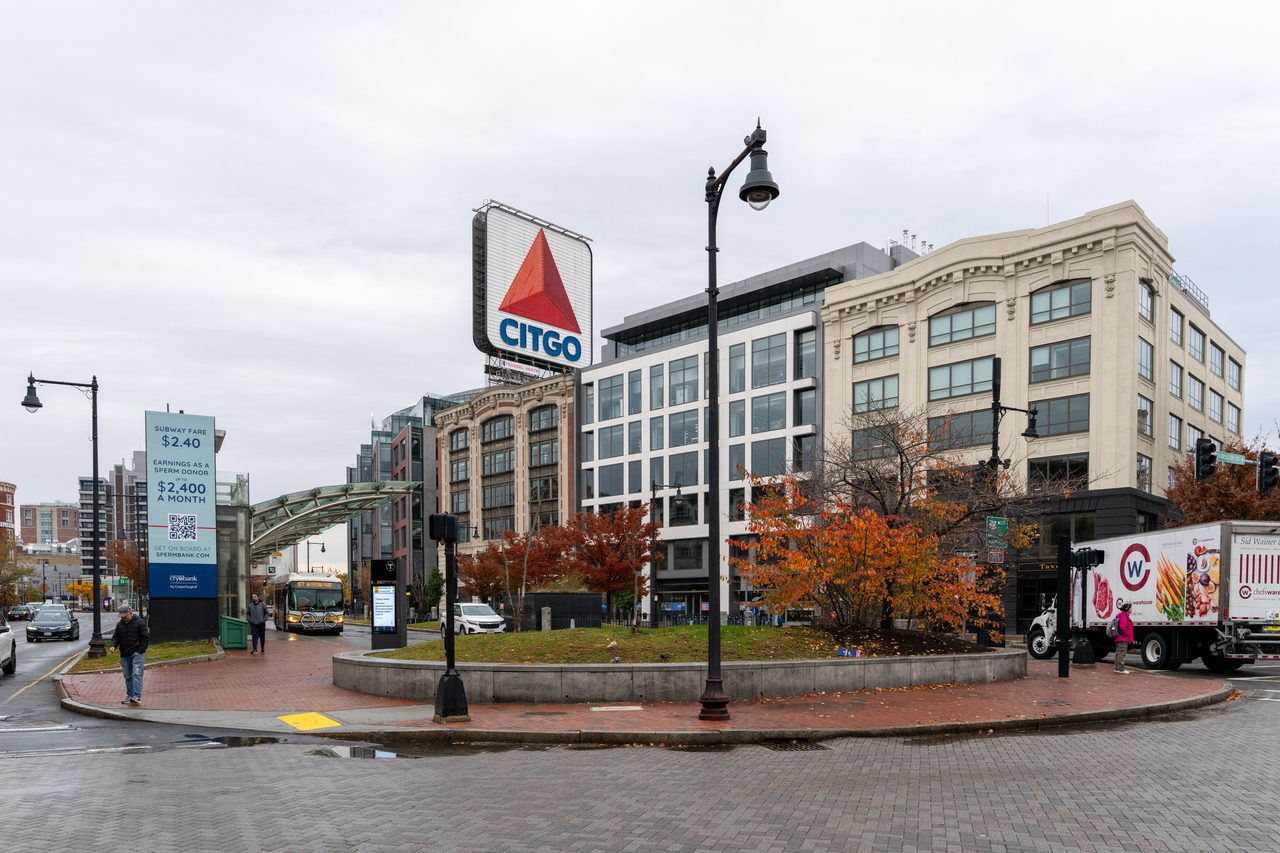
Back into Boston, past the Citgo sign in Kenmore Square at mile 25.2 ('1 mile to go'), under Massachusetts Avenue, right onto Hereford Street and left onto Boylston Street, to the finish near the Boston Public Library in Copley Square.
Citgo sign, mile 25.2Finish, Boylston Street
Look up as you turn onto Boylston: it's the photo you'll frame.
The organisers publish a course map, not a course file, so the line is the course as mapped on OpenStreetMap, checked against the official map's turns. The miles in the text are the organisers' own and the km are those miles converted, except where a place has no official mile: those km are measured along the mapped line.
05
How hilly is the Boston Marathon?
Yes, late on. The course drops from Hopkinton for the first miles, and the climbing comes late: the organisers call miles 17.5 to 21 the Newton hills, ending with Heartbreak Hill, which crests at mile 20.8. From there it's mostly downhill to Boylston Street.
The early downhill and the late climbs are what to train for. The chart below is drawn from a public elevation model on the mapped course, so its heights are approximate: the organisers' own profile is on their course map.
17.5–21Miles of the Newton hillsOfficial
Mile 20.8Heartbreak Hill's crestOfficial landmark
1936Heartbreak Hill namedOfficial history
2:01:52Course recordJohn Korir, 2026
0 m40 m80 mLower Fallsout of the river valleyComm Avethe first Newton hillCity Hallpast mile 19Heartbreakcrest at mile 20.8
0 km51015202530354042.2
Heights are approximate. The organisers publish no course file, so these come from the US Geological Survey's 10 m bare-earth elevation model (public domain) on the course as mapped on OpenStreetMap, smoothed over about 250 m: treat the shape as a guide, not the metres.
Hover or drag along the chart to read the heights.
Where it bites
km 0–6
The downhill start
From the line on Main Street the road drops through Hopkinton and Ashland.
Hold back: the downhill takes from your legs what the hills need later.
km 18.9–25.6
Wellesley
The Scream Tunnel at Wellesley College, just before halfway, then Wellesley Square.
Enjoy it, and keep your pace where it was.
km 25.4–26.5
Out of Newton Lower Falls
After the drop to the river at Newton Lower Falls, the road climbs up Washington Street.
Not one of the named hills, but it starts the climbing: settle in.
km 28.2–33.8
The Newton hills
Miles 17.5 to 21, on Commonwealth Avenue, after the right turn at the fire station: a climb, then down, then up again, past the Johnny Kelley statue at mile 19.2.
Shorten your stride and keep your cadence up each climb.
km 32.4–33.5
Heartbreak Hill
The last of the Newton hills, cresting at mile 20.8. A Boston Globe reporter named it in 1936, when Ellison 'Tarzan' Brown retook the lead from John A. Kelley on it.
Once you're over the top, it's mostly downhill to the finish.
km 33.5–42.2
Downhill to Boylston
Down past Boston College, along Beacon Street, past the Citgo sign at mile 25.2 and under Massachusetts Avenue.
After Massachusetts Avenue there are two turns to go: right on Hereford, left on Boylston.
06
Race week and race morning
In 2026 the race weekend ran from the Expo's opening on Friday 17 April to the marathon on Monday 20 April. The Boston 5K, the B.A.A. Invitational Mile and the first B.A.A. Youth Mile were on the Saturday, all finishing on Boylston Street. Times marked Official are the organisers' 2026 times; the rest is our suggestion.
OfficialFrom the organisers' siteSuggestedOur adviceReportedFrom runners' reports
Race week
Race morning: start times and a suggested schedule
Start
Main Street, Hopkinton
Finish
Boylston Street, Boston
Waves
Six, from 10am to 11:21am
Finish closes
5:30pm
Your wave sets your bus and your walk to the start: the full table of bus, Athletes' Village and corral times is on the official site.
Gear check opens
Official
On Boylston and Berkeley Streets, until 9:15am. Collect your bag there after the race, from 11:30am to 6pm.
Wave 1's buses start loading
Official
On Charles Street. Waves 2 and 3 load from 7:30am, waves 4 and 5 from 8am and wave 6 from 9am. Show your bib to board.
Hopkinton
Settle in at the Athletes' Village
Suggested
At Hopkinton Middle and High School, with water, Gatorade and toilets. It's a long wait for the early waves: bring layers you're happy to leave behind.
The wheelchair races start
Official
Men at 9:06am and women at 9:09am, then the handcycles and duos at 9:30am.
Wave 1 leaves the Athletes' Village
Official
By corral, between 9:15am and 9:30am, for the 0.7-mile walk to the start. The later waves follow on, until wave 6's last corrals at 10:50am.
The professional fields start
Official
The men at 9:37am and the women at 9:47am, then the Para Athletics Division at 9:50am.
Wave 1 starts
Official
Then wave 2 at 10:15am, wave 3 at 10:28am, wave 4 at 10:41am, wave 5 at 11:01am and wave 6 at 11:21am.
Everyone is on the course
Official
The organisers aimed to have every runner across the start line by 11:30am.
5:30pm
The finish line closes
Official
So the roads can reopen. Runners still on the course are asked to move to the sidewalk; anyone who finishes later still gets a medal, but isn't an official finisher.
After
Meet your people
Official
In the Family Meeting Area on Stuart Street, between Berkeley and Clarendon Streets, signed by the first letter of the runner's last name. Collecting your medal, drinks and food takes a while: tell them.
Where
Back Bay
Finish
The marathon finish line
The Boston 5K
Official
From near Boston Common through Back Bay to the marathon finish line on Boylston Street: 9,306 finished it in 2026.
The B.A.A. Invitational Mile
Official
Professional milers, and students from each of the eight cities and towns on the marathon course, on Boylston Street.
The B.A.A. Youth Mile
Official
Its first year: for children aged 7 to 14, free, on Boylston Street over the marathon finish line.
07
Where to watch the Boston Marathon
Boston is point to point, so plan before you go: the organisers suggest a strategy if you want to see a runner in more than one place. The Commuter Rail stops near the course in Ashland, Framingham, Natick and Wellesley, and Green Line stops serve Newton, Brookline and Boston. Follow your runner in the free B.A.A. Racing App, keep off the course, and agree a meeting point: the Family Meeting Area is on Stuart Street, between Berkeley and Clarendon Streets.
See the field leave Main Street, from the wheelchair starts at 9:06am to the last wave at 11:21am. Limited spectator parking is at Hopkinton State Park, with shuttles on race morning.
The organisers' pick in Framingham: watch the runners pass the depot, then take the inbound Commuter Rail towards Boston. Check the race-day train times first.
Wellesley College's Scream Tunnel, just before halfway, is one of the loudest spots in road racing, by the organisers' account. A quieter, sensory-friendly viewing area is at the Tolles Parsons Center, 500 Washington Street, around mile 13.5.
The finish straight. Accessible viewing is at the corners of Boylston with Hereford Street, Ring Road, Fairfield Street and Exeter Street. You can't park near the finish: come by train.
The Green Line or the Orange Line: check race-day closures
08
Race-morning weather
Cool and dry: 45°F (7°C) at the start in Hopkinton, with a slight tailwind, which the organisers called almost-ideal conditions. At Boston Logan Airport the day's low was 3.3°C and its high 11.7°C, with no rain and the strongest winds from the west, at the runners' backs (NOAA). For the next race's forecast, see the official site and the B.A.A. Racing App in race week.
7°CAt the start12°CBoston's high
0°C10°C20°C30°C
Sunrise just before 6am, four hours before Wave 1
Recent race mornings
202620 Apr
Dry, with a slight tailwind: 45°F at the start in Hopkinton, by the organisers' report
7°C at the startHigh 11.7°C in Boston
202521 Apr
Dry, at Boston Logan Airport (NOAA)
Low 6.1°CHigh 13.3°C
09
How to get into the Boston Marathon
Most places go to qualifiers: for 2026, 24,362 of the 30,000 places went to runners who applied with a qualifying time, the fastest under their standard first. The rest were invitational entries, including charity runners and the professional and Para athletes. The standards, the dates and the latest cut-off are on the official site.
A qualifying time
Run your age and gender's qualifying standard on a certified marathon course in the qualifying window, then apply in registration week. Places go to the fastest under their standard, not first come, first served, so meeting it doesn't guarantee one.
The Boston Qualifier Selection
New for 2027: a random draw for qualifiers whose time met their standard but wasn't fast enough for a place. Qualifiers who apply are in it automatically.
A charity place
Through the Bank of America Official Charity Program: its member charities recruit runners who pledge to raise funds for them. The B.A.A.'s own Gives Back Marathon Team fields fundraising runners too.
An international tour operator
The B.A.A. works with select tour operators abroad. In Australia and New Zealand they are Marathon Tours & Travel, Travelling Fit and Marathon Tours New Zealand.
John Korir of Kenya won the men's race in 2:01:52, a course record, ahead of Alphonce Felix Simbu (2:02:47) and Benson Kipruto (2:02:50). Sharon Lokedi of Kenya won the women's race in 2:18:51, ahead of Loice Chemnung (2:19:35) and Mary Ngugi-Cooper (2:20:07). Marcel Hug won the men's wheelchair race in 1:16:06 and Eden Rainbow-Cooper the women's in 1:30:51.
Where can I find my 2026 result?
On the B.A.A.'s results site for 2026, boston.r.mikatiming.com/2026, linked from the results page of baa.org, and in the B.A.A. Racing App.
What was the weather like at the 2026 Boston Marathon?
Cool and dry: 45°F (7°C) at the start in Hopkinton, with a slight tailwind, by the organisers' report. At Boston Logan Airport the day's low was 3.3°C and its high 11.7°C, with no rain (NOAA).
How many people ran the 2026 Boston Marathon?
32,294 runners were entered the evening before the race, and the organisers expected 30,000 to run, with about 10,000 volunteers along the course.
What did 2026 finishers get?
A finisher's medal, a Heatsheet blanket, water, Gatorade and a food bag at the finish, and a participant shirt, collected with the bib at the Expo.
Where were the drink stations in 2026?
Water and Gatorade at every mile from mile 2, on both sides of the road, with toilets at every aid station. Maurten gels were at mile 11.8 on the Wellesley town line, mile 17 in Newton and mile 21.5, just after Boston College. There were 26 medical stations along the course.
When is the next Boston Marathon?
The 131st Boston Marathon is on Monday 19 April 2027.
Where does the Boston Marathon start and finish?
It starts on Main Street in Hopkinton, Massachusetts, and finishes on Boylston Street in Boston, near the Boston Public Library in Copley Square. It's point to point, through eight cities and towns.
Is the Boston Marathon hilly?
It drops for the first miles from Hopkinton, then climbs late: the organisers call miles 17.5 to 21 the Newton hills, ending with Heartbreak Hill, which crests at mile 20.8. From there it's mostly downhill to the finish.
Why is it called Heartbreak Hill?
A Boston Globe reporter, Jerry Nason, named it in 1936, after Ellison 'Tarzan' Brown retook the lead from John A. Kelley on the last of the Newton hills, and, as Nason put it, broke Kelley's heart.
How do you get into the Boston Marathon?
Mainly with a qualifying time for your age and gender, run on a certified course: qualifiers apply in registration week and the fastest under their standard are accepted. The other ways in include the Official Charity Program, the B.A.A.'s own charity team and international tour operators. You must be 18 or over on race day.
How do runners get to the start?
On the organisers' buses from Charles Street, between the Public Garden and Boston Common, loading by wave. Runners wait in the Athletes' Village at Hopkinton Middle and High School, a 0.7-mile walk from the start, and leave it by wave and corral.
Is there a bag drop?
Yes, in Boston, not at the start: on race morning you check the clear bag from your packet on Boylston and Berkeley Streets, two blocks past the finish. Only the small start area bag is allowed on the buses and in Hopkinton, and clothes left there are donated.
Is there a time limit?
The finish line closes at 5:30pm, so roads can reopen. Runners still on the course are asked to move to the sidewalk, and anyone who finishes after 5:30pm still gets a finisher's medal, but isn't an official finisher in the results.
Where can my family watch?
Anywhere along the 26.2 miles, but plan ahead: it's point to point. The organisers point to the start in Hopkinton, Framingham's train depot, Natick Common, Wellesley's Scream Tunnel, the Newton hills, Beacon Street in Brookline and Boylston Street. The Commuter Rail and the Green Line run near the course.
Where should we meet after the finish?
In the Family Meeting Area on Stuart Street, between Berkeley and Clarendon Streets, with meeting points by the first letter of the runner's last name. Getting there from the finish takes a while, so agree a plan before the race.
When was the first Boston Marathon?
On 19 April 1897, from Metcalf's Mill in Ashland to the Irvington Oval in Boston, 24.5 miles. John J. McDermott won it in 2:55:10. The start moved to Hopkinton in 1924, when the course was lengthened to 26 miles 385 yards.

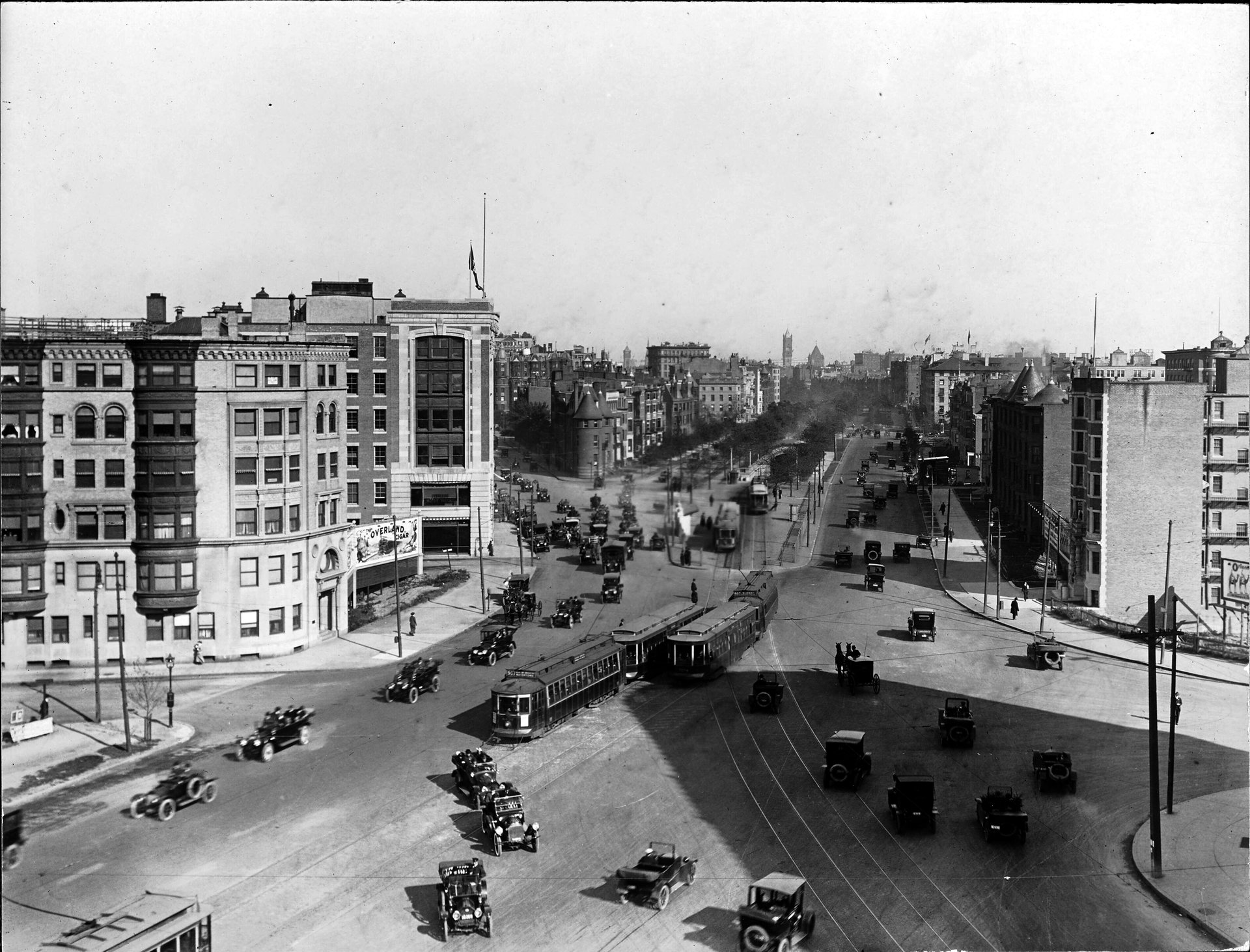
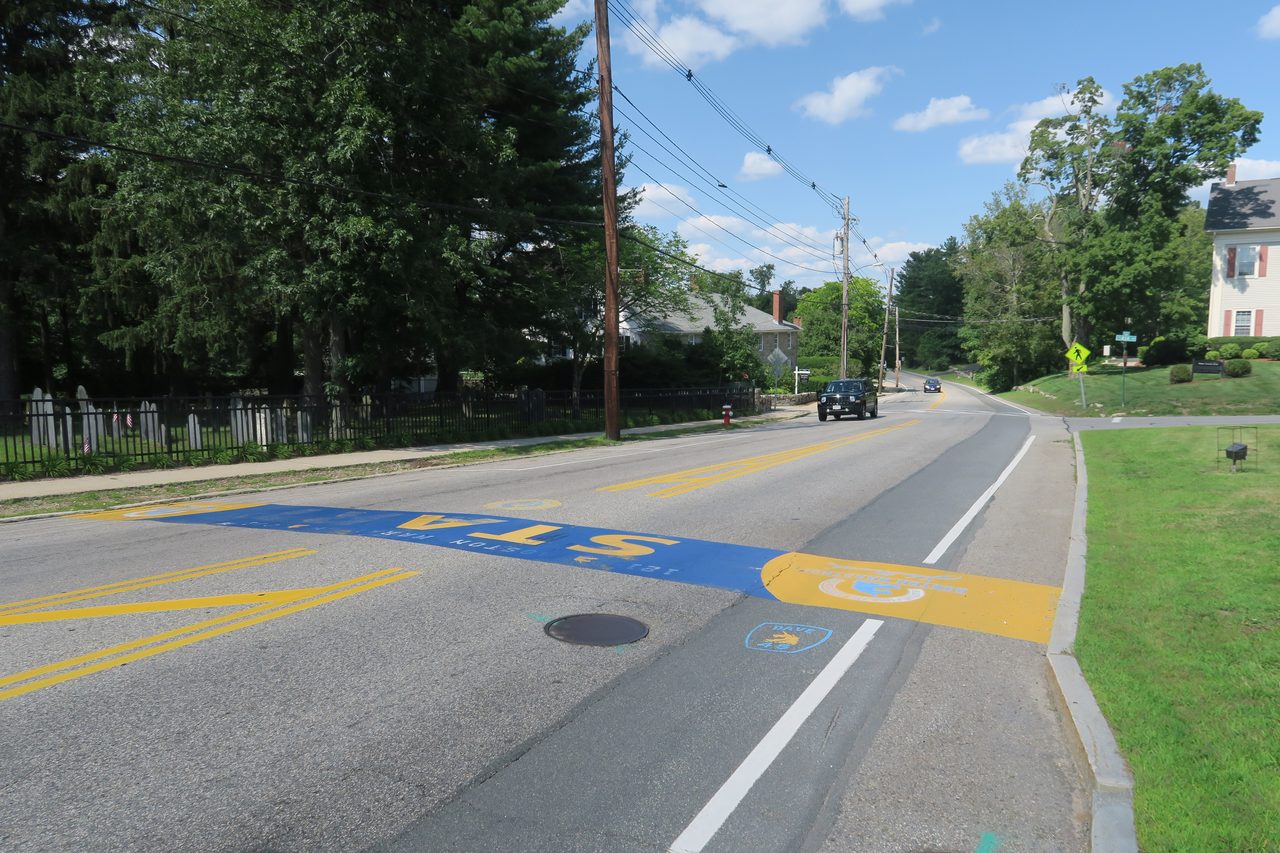 Photo: John Phelan, CC BY-SA 4.0